Send files that only the right person can open
CryptDrop encrypts files in your browser with OpenPGP. No account required. CryptDrop does not upload your file contents.
Once the app is loaded and the required keys are available, file encryption and decryption run locally. Key discovery and invitations need a network connection. Review security details and limitations.
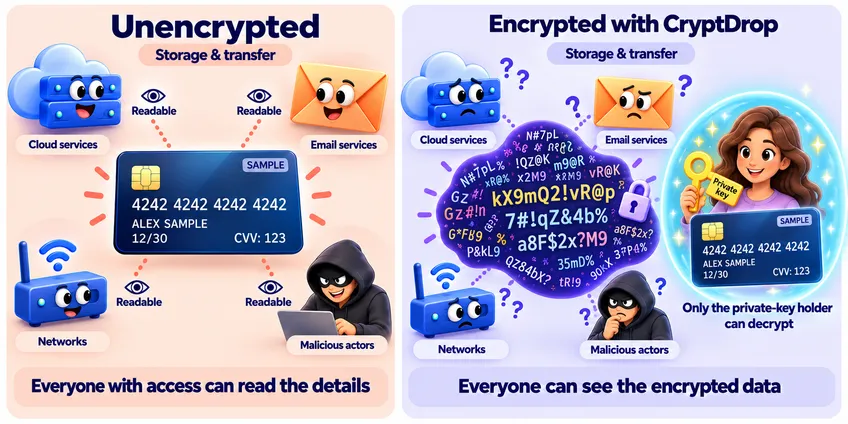
The problem with sending files today
Every file you share online passes through routers, servers, and services you don't control. Any one of them could read, copy, or leak your data.
Email isn't private
Email providers can read your attachments. Forwarded messages lose all control. There's no guarantee only your recipient sees the file.
Cloud links can leak
Shared links can be guessed, forwarded, or accessed by platform employees. Revoking access after the fact is damage control, not prevention.
No way to verify the sender
Standard file sharing has no built-in way to prove who actually sent a file or whether it was modified in transit.
CryptDrop solves this
Encrypt any file so that only the person you choose can open it. Sign it so they can verify it came from you. All in your browser.
End-to-end encryption
Files are encrypted with the recipient's public key. Only their private key can decrypt it — not CryptDrop, not your ISP, not anyone in between.
Digital signatures
Sign files with your private key to prove authenticity. The recipient can verify the file came from you and wasn't tampered with.
100% browser-based
Encryption and decryption run locally in your browser with OpenPGP.js. File contents, private keys and passphrases are not uploaded by these workflows. Public-key registration, lookup and invitations use network services. Details and limitations.
Public key discovery
Find public keys by email through the CryptDrop registry, with keys.openpgp.org as a fallback. No need to exchange keys manually.
Private keys stay local
File processing stays on your device. Registry and invitation services receive public keys and identity or contact details, not private keys. Learn what uses network services.
No account required
Generate keys, encrypt, and decrypt without an account or login. Key generation asks for a name and email and attempts to register your public key and identity with CryptDrop.
How it works in three steps
-
Generate your keys
Create a key pair in seconds. Your public key lets others encrypt files for you. Your private key stays on your device, protected by a passphrase.
-
Encrypt (optionally sign)
Find the recipient's public key by email, drop in your file, and click encrypt. The file is locked so only they can open it. Optionally sign with your private key so the recipient can check the signature.
-
Decrypt (optionally verify)
The recipient loads their private key and drops in the encrypted file to decrypt it. If the file is signed, add the sender’s public key to check its signature.
How CryptDrop compares
Scroll horizontally to compare all columns on smaller screens. Keyboard: focus the table region, then use the arrow keys.
| Feature | CryptDrop | Cloud Storage | Messaging Apps | |
|---|---|---|---|---|
| End-to-end encrypted | Yes | No | No | Yes * |
| Files stay on your device | Yes | No | No | No |
| Sender verification | Yes | No | No | No |
| No account required | Yes | No | No | No |
| No file storage on service servers | Yes | No | No | No |
| Open standard (OpenPGP) | Yes | No | No | No |
| Local encryption & decryption after loading app and keys | Yes | No | No | No |
* Some messaging apps offer E2E encryption for messages, but typically not for file transfers, and lack sender verification via cryptographic signatures.
Your files. Your keys. Nobody in between.
CryptDrop is free, open-source, and runs file encryption in your browser. Start sending secrets safely.